

What Dryer Vent Repair Actually Covers
Crown Air Duct Cleaning is based in St. Cloud, FL, serving homeowners and businesses across Osceola County, Kissimmee, Orlando, and Poinciana. Dryer vent work is one of the most misunderstood services we do.
Learn more about air duct repair St Cloud Florida →
Learn more about air duct sealing services Florida in Poinciana, FL →
Learn more about chimney repair St Cloud FL in Kissimmee, FL →
About Crown Air Duct →"Repair" covers torn flex duct, disconnected joints, crushed sections, damaged wall caps, and improper transitions. It does not always mean the whole vent needs replacing.
Repair vs. Cleaning vs. Replacement
Most homeowners confuse these three. A cleaning removes lint and debris from an intact vent. A repair fixes structural damage to the duct itself. A replacement swaps out the entire run. You might need one, two, or all three depending on what we find.
Why Florida Homes Are More Vulnerable
Florida's heat and humidity accelerate duct material degradation. Flexible plastic duct, which was commonly installed in older Central Florida homes, can crack, sag, and separate within a few years under attic temperatures that regularly hit 130 degrees in summer. Rigid metal holds up far better.
See also: Dryer vent cleaning St Cloud FL: A Homeowner's Guide for a full walkthrough of local conditions and what to watch for year-round.
What We Check First
- ✓ Wall cap condition and airflow at the exterior termination
- ✓ Full length of the duct run for crushed or disconnected sections
- ✓ Material type (plastic flex is always a flag)
- ✓ Number of bends and total duct length against dryer specs
- ✓ Lint accumulation at transitions and inside the drum

The Real Case For (and Against) Repair
Here is the honest breakdown a technician would give you in your driveway before starting the job.
When Repair Clearly Pays Off
If your dryer is running long cycles, clothes feel damp after a full dry, or the laundry room gets unusually hot, the vent is almost always part of the problem. Restricted airflow makes your dryer work harder, which shortens the motor's life and drives up your electric bill.
A single disconnected joint in the duct, something that takes under an hour to fix, can dump moist lint-laden air directly into a wall cavity or attic space. Left alone, that leads to mold. The repair cost is small compared to mold remediation.
The U.S. Fire Administration reports that dryers cause around 2,900 home fires per year, with failure to clean the vent listed as the leading contributing factor. A repaired duct that actually vents to the outside is the starting point for fire prevention.
- → Dryer cycles running 60 minutes or more on normal loads
- → Visible crushed or disconnected flex duct behind the unit
- → Exterior cap that does not open when the dryer runs
- → Burning or musty smell during a cycle
- → Excess heat or humidity in the laundry room
The Fire Risk Is Real
Lint is highly flammable. When a duct is torn or disconnected, lint collects at that gap instead of exiting at the cap. Over time, the heat from a running dryer can ignite it. Learn why dryer vent fires happen and how to avoid them before it becomes an emergency.
home dryer fires per year in the U.S., according to the U.S. Fire Administration. Most are preventable with proper venting.
Energy Cost Impact
A blocked or leaking vent forces the dryer to run extra cycles. Over a year, that adds up. How much depends on your dryer wattage and how often you run it, but most technicians see cycle times drop by 20 to 40 percent after a repair and cleaning combination. Is dryer vent cleaning worth it? Read that before deciding.
When Repair Might Not Be Enough
If the vent run is plastic accordion-style flex duct and it was installed more than five years ago, repair gets complicated. Patching plastic flex is possible but not a long-term fix. The material tends to re-tear at or near the patch, especially in a hot attic environment.
Current building codes in Florida require smooth-wall rigid metal duct for dryer venting, or semi-rigid metal at a minimum. If your existing duct is plastic, a repair job that meets code means upgrading the material at the same time. That shifts the cost closer to a replacement, though the labor for a straight run in a single-story home is still typically a half-day job.
Very long duct runs (over 25 feet equivalent length, accounting for elbows) are another situation where repair alone may not restore proper airflow. The National Fire Protection Association sets standards for duct length and elbow equivalents in NFPA 211. Exceeding those limits means rerouting, not just patching.
- ◆ Plastic flex duct older than 5 years
- ◆ Duct run exceeds 25 feet equivalent length
- ◆ Multiple disconnected sections or heavy crushing
- ◆ Vent terminates inside the attic or wall cavity instead of outside
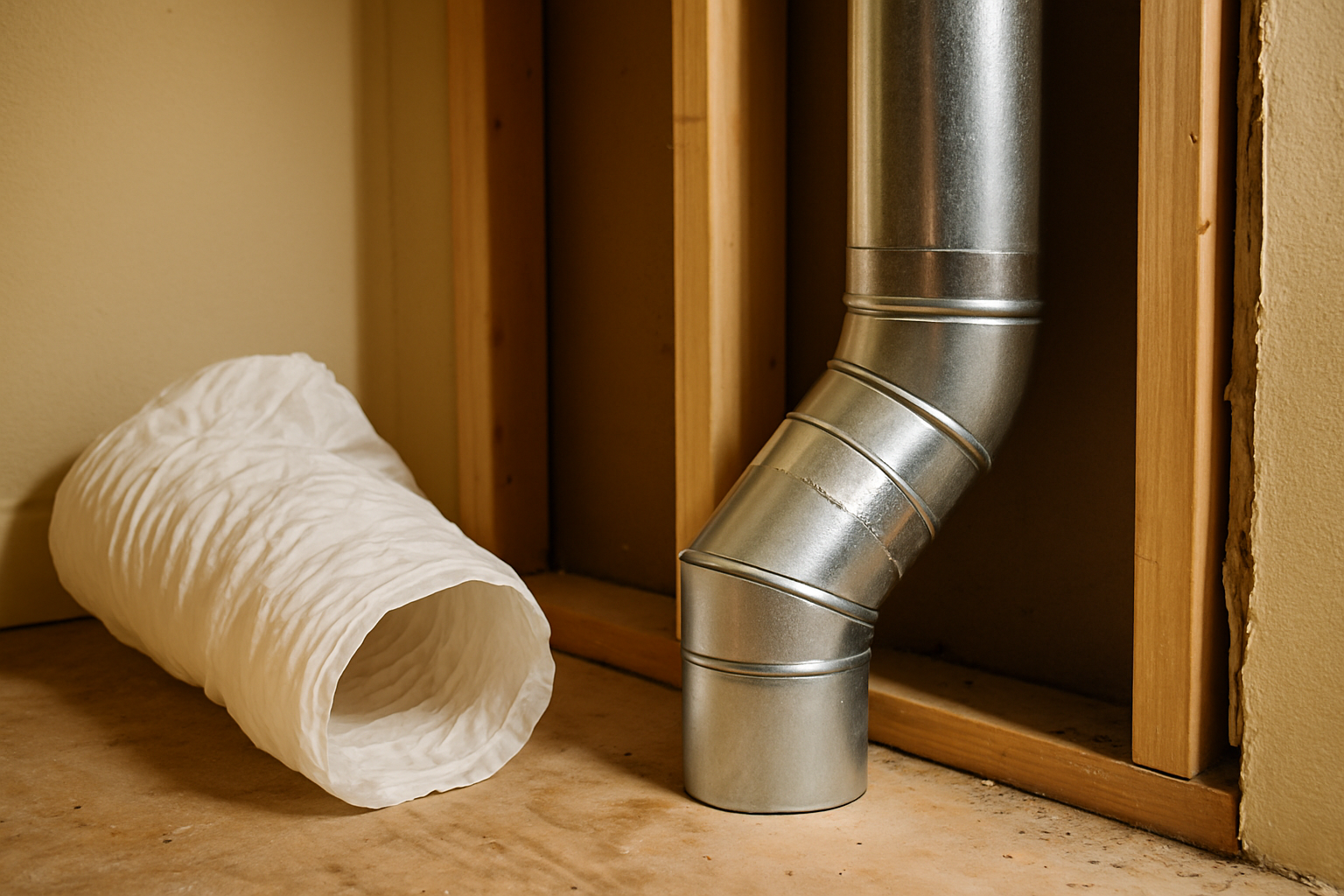
Plastic Flex: Just Say No
The 2021 Florida Building Code requires smooth-wall rigid or semi-rigid metal duct for new dryer vent installations. If your home still has the old plastic accordion style, it is worth knowing that blockages in plastic flex are harder to clear and the material itself poses a higher fire risk.
When "Repair" Becomes "Replace"
Honest answer: if more than a third of the duct run has problems, replacement is usually more cost-effective than patching section by section. We will tell you that upfront rather than piece-meal the work.
How the Repair Process Works
Step by step, no surprises.
Visual Inspection and Airflow Test
We pull the dryer out and inspect the transition hose, the in-wall or in-attic duct, and the exterior cap. We run the dryer and check airflow at the termination point. Weak airflow at the cap almost always points to a blockage or a break somewhere in the run.
Locate and Diagnose the Damage
Most disconnections are accessible from the laundry room side or from the attic. Occasionally a section runs through a finished wall and requires cutting an access panel. We tell you before we cut anything and explain why it is necessary.
Repair or Replace the Damaged Section
For rigid metal: we reattach, seal joints with foil tape (never standard duct tape, which fails in heat), and verify slope. For plastic flex that needs upgrading: we swap it for semi-rigid or rigid metal. This part of the job typically takes one to two hours.
Clean the Repaired Duct
Once the duct is structurally sound, we run a rotary brush and high-powered vacuum through the full length to remove accumulated lint. Skipping this step after a repair leaves the fire hazard in place. See the full process details at our Dryer Vent Cleaning Services page.
Final Airflow Verification
We rerun the dryer and confirm the cap opens freely and airflow is strong at the termination. Total job time for a straightforward repair plus cleaning: two to four hours in most St. Cloud area homes.
Common Questions
Honest answers, not marketing copy.
Can I repair the vent myself?
For a transition hose swap right behind the dryer, yes. For anything inside a wall or attic, you need access to the full run, the right foil tape (not hardware-store duct tape), and knowledge of the code-required maximum duct length. Getting it wrong can create a hidden fire hazard. If you're not sure, a professional inspection is worth it.
How much does dryer vent repair cost in Florida?
Costs vary with duct length, material type, and access difficulty. A simple reconnection and cleaning at one joint runs less than a full duct replacement from attic to exterior wall. We provide a free estimate before any work begins, so there are no surprises. Avoid any company that quotes a flat price without seeing the job first.
How often does a dryer vent need service?
The NFPA recommends cleaning at least once per year. In Florida, higher humidity means lint can compact and stick faster. Families doing more than six loads per week should consider every six months. Read more at Dryer Vent vs Dryer Duct Cleaning.
What about indoor dryer vents?
Indoor vent kits trap lint in water reservoirs rather than venting outside. They are not code-compliant for gas dryers and create serious moisture and air quality problems in humid Florida homes. We cover this in detail at Do Indoor Dryer Vents Really Work?
Do you handle air duct repairs too?
Yes. Crown Air Duct handles the full picture: air duct repair, air duct sealing, and full air duct cleaning throughout Central Florida. If you're noticing uneven temperatures or high energy bills, the signs your air ducts need repair guide is a good starting point.